"I don't have too much to do today, so I
think I'll get in some flying time."
Spacecraft: Sigma 7
Pad LC-14
Launch Vehicle:
Atlas
Crew: Walter M. Schirra, Jr.
NASA Milestones: Six-orbit
engineering test flight
Payload: Spacecraft No. 16, Launch Vehicle 113-D
Mission Objective: Man-machine in orbit for 9 hours
Orbit:
Altitude: 175.8 by 100 statute miles
Orbits: 6
Period: 88min 55sec
Duration: 0 Days, 9 hours, 13 min, 11 seconds
Distance: 143,983 statute miles
Velocity: 17,558
Max Q: 964
Max G: 8.1
Launch:
October 3, 1962, Cape Canaveral, Florida
Landing: October
3, 1962, Pacific Ocean, Recovery Ship: Kearsarge
Mission Highlights: Mission
successful. Total time weightless 8 hours 56min 22 sec.
Wally's
Favorite Flight Milestones:
Falling asleep on the way to the launch pad.
Answering Slayton on the on board voice
recorder "YBYSAIA"
Solving the coolant valve settings during the
first orbit. Slowly adjusting.
Saving almost all of the attitude control
fuel by minimum thruster use instead of automatic attitude
thrusters. Flew in "Chimp Mode" rarely.
Preflight work on reading yaw attitude. This
saved Cooper on MA-9
First Mercury flight to land near carrier and
picked up to be placed by # 3 elevator.
Blew hatch on carrier deck and wounded right
hand from recoil of push button, proving that Grissom did
not blow hatch on his flight.
Wally's 50th on the ISS
click to enlarge
Schirra was named as one of the "Original Seven"
Mercury Astronauts on April 9, 1959. NASA announced that the seven
men, Alan B. Shepard, Jr., Virgil I. "Gus" Grissom, John H. Glenn,
Jr., M. Scott Carpenter, Schirra, L. Gordon Cooper, Jr., and Donald
K. "Deke" Slayton, had been selected from among 110 of the nation's
top military test pilots to train as astronauts for Project Mercury,
the first phase of the U.S. space program, involving one-man
suborbital and orbital missions. Schirra, Shepard and Carpenter were
from the Navy; Grissom, Cooper, and Slayton were from the Air Force;
and Glenn was from the Marine Corps.
Schirra's special responsibility in Project Mercury was the
development of environmental controls or life-support systems that
would ensure the safety and comfort of the astronaut within the
spacecraft during the mission. His tasks also included the testing
and improvement of the pressurized suit worn by the astronauts.
On May 24, 1962, he served as backup pilot for
MA-7, the three orbit mission flown by Carpenter. On June 27, 1962,
Schirra was designated for America's fifth manned space mission and
third orbital flight, originally scheduled for September 28, 1962. A
malfunctioning fuel-control valve delayed the flight of MA-8 until
October 3, 1962. Schirra piloted the capsule Sigma 7 on a
six-orbit mission lasting 9 hours, 13 minutes, and 11 seconds. The
capsule attained a velocity of 17,557 miles per hour and an altitude
of 175 statute miles, the capsule traveled almost 144,000 statute
miles before reentry into Earth's atmosphere. He proved that an
astronaut could carefully manage the limited amounts of electricity
and maneuvering fuel necessary for longer, more complex flights. He
chose the name Sigma because it symbolized engineering
precision, and the result was precisely engineered flight that many
have termed a "textbook spaceflight." The capsule splashed down only
4.5 miles from the aircraft carrier Kearsarge in the Pacific
Ocean about 275 miles northeast of Midway Island. He was later
awarded with the NASA Distinguished Service Medal for his work in
the Mercury Project.
Click on photo to enlarge
I named my spacecraft Sigma Seven. Sigma
"Σ", a Greek symbol for the sum of the
elements of an equations, stands for engineering excellence. That
was my goal - engineering excellence. I would not settle for less.
I proved man's advantage in space in other ways. With
the photographic experiments, for example, I took the approach of an
engineer rather than a sightseer. I sought advice from professional
photographers such as Ralph Morse and Carl Mydans of Life and
Dean Conger and Luis Marden of National Geographic. I decided
that a Hasselblad, with its larger film frame, was more suitable
than a 35 mm camera. I had the Hasselblad adapted. A 100 exposure
film container was installed, and an easy aiming device was mounted
on the side of the camera. Focusing would not be required from the
infinity of space, I figured. Finally I learned how to repair the
Hasselblad.
Scientific observations were on my agenda as well.
I observed the planet Mercury, not normally seen from earth, because
the apparent position of Mercury is close to the sun. In orbit we're
not affected by the diffuse light of the atmosphere, so I would see
Mercury as it passed through layers of light. I tracked its passage
against a yardstick of time.
all photos courtesy of Win Perkins
click to enlarge
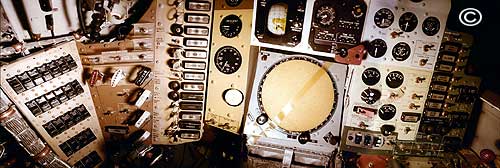
ASCS Switches
Attitude Indicator Sat. Clock
ECS Controls
ECS Panel
Electrical and Communications Systems
Floor Foot Restraints
Couch Head Postion
Helium Supply Egress
Interior Shot
Interior Shot
Interior Shot
Interior shot
Abort Handle
Interior Periscope
Light Fixture
Lower Couch ECS Hookups
Map Case
Pitch and Yaw Links
Periscope
Pilot Camera, Clock
Mercury RHC
Tape Recorder
Warning Panel Fuses
Window
Window Swizzle Stick
Window
Post flight notes written by Wally Schirra
Post flight notes written by Wally Schirra
Post flight notes written by Wally Schirra
Notes from 1959 regarding Mercury project
Notes from 1959 regarding Mercury project
Notes from 1959 regarding Mercury project
Notes from 1959 regarding Mercury project
Much thanks to Jim Sigler for having
Wally's home town issue an official proclamation
recognizing the 50th anniversary of the flight of Sigma 7 on October 3,
1962
'Sigma 7' at 50: Retro Space Images recall 5th US manned
spaceflight
October 3, 2012 � Fifty years ago, the
United States launched its fifth astronaut into
space.
Walter M. "Wally" Schirra, Jr. rode his one-man
Mercury spacecraft atop an Atlas rocket to orbit
on Oct. 3, 1962. The nine-hour mission on the
"Sigma 7" capsule was the longest to date for a
U.S. flight and set the stage for the day long,
final mission of the Mercury Program that
followed.
Schirra, whose choice of the Greek letter
"Sigma" for his spacecraft's name was meant to
reflect his flight's focus on technical
evaluation, wrote in his biography that he
strove for "engineering excellence." To that
end, the almost flawless flight of Sigma 7 ended
with a nearly-perfect splashdown, landing just
half a mile (0.8 kilometers) from the Navy's
recovery ship.
"I think they're gonna put me on the number 3
elevator" of the aircraft carrier the USS
Kearsarge, Schirra joked of his
parachute-assisted descent. It could have been
the ultimate of Schirra's "gotchas" � jokes that
he infamously pulled on his friends, colleagues
and later crewmates.
He could fall victim to them, too. Just three
minutes into the Mercury-Atlas 8 mission,
capsule communicator, or capcom, Deke Slayton
radioed Schirra with a simple-to-ask but
complicated-to-answer question, "Hey, Wally, are
you a turtle?" A tradition carried over from
World War II pilots, the correct reply, "You bet
your sweet ass I am!" was not something Schirra
could broadcast to the world below. The penalty
for not responding, however, was having to buy
all those listening a drink of their choice.
Not missing a beat, Schirra switched from live
radio to his onboard recorder and spoke the
"correct answer," as NASA's official transcript
would later note.
Beyond the jokes, Schirra conducted observations
of the planet Mercury, tracking its passage as
seen through the upper layers of Earth's
atmosphere, and flew the first Hasselblad camera
in space, a model he himself chose and purchased
at a local Houston photo shop.
Schirra also bought and wore on Sigma 7 the
first Omega Speedmaster watch to fly in
space, initiating the chronograph's long legacy
as the timepiece of choice for both astronauts
and cosmonauts to this day.
Schirra, who went on to fly Gemini and Apollo
missions � the only astronaut to fly all three
of NASA's early piloted spacecraft �
died in May 2007 at age 84. His Mercury
capsule, Sigma 7, is today on display at the
U.S. Astronaut Hall of Fame in Titusville, Fla.,
where Schirra is honored as one of the Hall's
original inductees.
Retro Space Images, which recently released
for sale an archive of almost 500
images from the Mercury-Atlas 8 mission,
chose the following photos to visually retell
the 50 year old flight of Wally Schirra on Sigma
7.
Walter M. "Wally" Schirra, Jr. was one of the
seven Mercury astronauts named by NASA in April
1959. A captain in the U.S. Navy, Schirra was 39
years old when he became the fifth American in
space aboard the Mercury-Atlas 8 mission on Oct.
3, 1962.
Here, Schirra shows his Mercury spacesuit helmet
to his 12-year-old son, Walter M. Schirra, III.
Together with his wife Jo, Schirra had two
children, including a daughter Suzanne, who had
just turned five, four days before he launched
on Sigma 7.
Schirra was originally scheduled to launch on
Sept. 28, 1962, but a malfunctioning
fuel-control valve delayed his flight. His
booster for the mission, an Atlas LV-3B, or
Atlas D Mercury Launch Vehicle, is seen here
leaving the General Dynamics facility in San
Diego, Calif.
The spacesuit that Schirra wore, the Navy Mark
IV, was a full-body pressure suit originally
developed by the B.F. Goodrich Company and the
U.S. Navy to protect pilots in high-altitude
fighter aircraft operations. Its silver color
was from an aluminum-coated nylon.
(Above, right) President John F. Kennedy (at
right) toured Cape Canaveral's Launch Complex 14
with Schirra on Sept. 11, 1962, where he saw the
Mercury-Atlas 8 launch vehicle being prepared
for flight.
The Mercury astronauts didn't design or wear
mission patches as later flight crews would, but
working with RCA artist Cece Bibby, logos were
added to the spacecraft. Here Bibby hand paints
Schirra's "Sigma 7" insignia on the Mercury
capsule.
Schirra rode the rocket, but it took a mission
support team on the ground to make the
Mercury-Atlas 8 mission a success. Here, Schirra
(third from right in front row) poses at Complex
14 with his launch team.
Dee O'Hara (at right) served as the first nurse
to NASA's astronauts, including Schirra. She
famously became the subject of a "gotcha" when
Schirra and fellow astronaut Gordon Cooper
presented her an enormous "5 gallon urine
sample" � iodine-colored warm water.
Schirra launched at 7:15:11 a.m. EST on Oct. 3,
1962 from Complex 14 at Cape Canaveral, Fla. The
Sigma 7 capsule obtained a velocity of 17,557
miles per hour and an altitude of 175 miles,
traveling almost 144,000 miles in the course of
six orbits.
Schirra made the first pin-point landing from
space, splashing down in the Pacific Ocean, 273
miles northeast of Midway Island, 4.5 miles (7.2
kilometers) from the target point and just half
a mile from the USS Kearsarge, the mission's
prime recovery ship.
Schirra and Sigma 7, as seen in their
post-flight conditions onboard the USS
Kearsarge, Oct. 3, 1962.
Schirra visited Washington, D.C., to receive the
NASA Distinguished Service Medal from President
Kennedy on Oct. 16, 1962.
All photos courtesy of NASA/RetroSpaceImages.com
via collectSPACE.com